

Advertising Disclosure

Forex Brokers in Switzerland
-

Written by:
George Rossi -

Updated:
- Forex Trading Platform in Switzerland
- Top 5 Best Forex Brokers in Switzerland
- Forex Regulations in Switzerland
- Investor Protection Measures in Switzerland
- Switzerland Forex Brokers List
- How to Choose the Best Switzerland-Regulated Brokers
- Pros and Cons of Trading with Switzerland-Regulated Brokers
- Steps to Verify a Switzerland-Regulated Forex Broker
- FINMA vs EU Regulators
- Leverage Limits in Switzerland
- Frequently Asked Questions
Switzerland is known for its excellent banking system. It has become a symbol of financial stability and wealth as a world jurisdiction that stores money and provides top-notch banking services.
Forex Trading Platform in Switzerland
Trading with foreign currencies in Switzerland is a well-regulated activity. To ensure the most successful and secure experience, it is essential to select a reliable broker. As Switzerland is a highly regulated jurisdiction, there are essential points and conditions to learn and consider:
- Owing to its highly reliable and trusted reputation in finance, global traders often choose to invest with Forex Brokers in Switzerland.
- Indeed, Switzerland Brokers provide fair and transparent trading conditions with unparalleled quality of service. However, the trading offerings have certain limitations.
- Forex Brokers that run entities in Switzerland and offer their services must be regulated and obtain a FINMA license to operate in the country.
- Switzerland is one of the last well-regulated jurisdictions offering high leverage for retail traders up to 1:100, and regulated trading of Binary Options.
- Since Switzerland is a very popular global financial hub, many scam brokers try to claim a Swiss license. Thus, it is crucial to verify licenses before making any investment decision.
Top 5 Best Forex Brokers in Switzerland
Below, we have compiled a list of the Best-Reviewed Brokers in Switzerland, according to the specified criteria and their trust scores. Although there aren’t many Swiss-based brokers, most European-regulated brokers can accept Traders from Switzerland due to regulation.
All the brokers stand out for their favorable conditions, advanced platforms, transparent pricing structure, dedicated customer support, and research and educational resources.
- Dukascopy – Best Overall Switzerland Brokers 2026
- Swissquote – Best MT4 Switzerland Broker 2026
- IG – Best Switzerland Broker for Beginners 2026
- CornerTrader – Best Switzerland Broker for Technical Trading 2026
- Saxo Bank – Best Low Spread Switzerland Broker 2026
Switzerland Forex Regulation
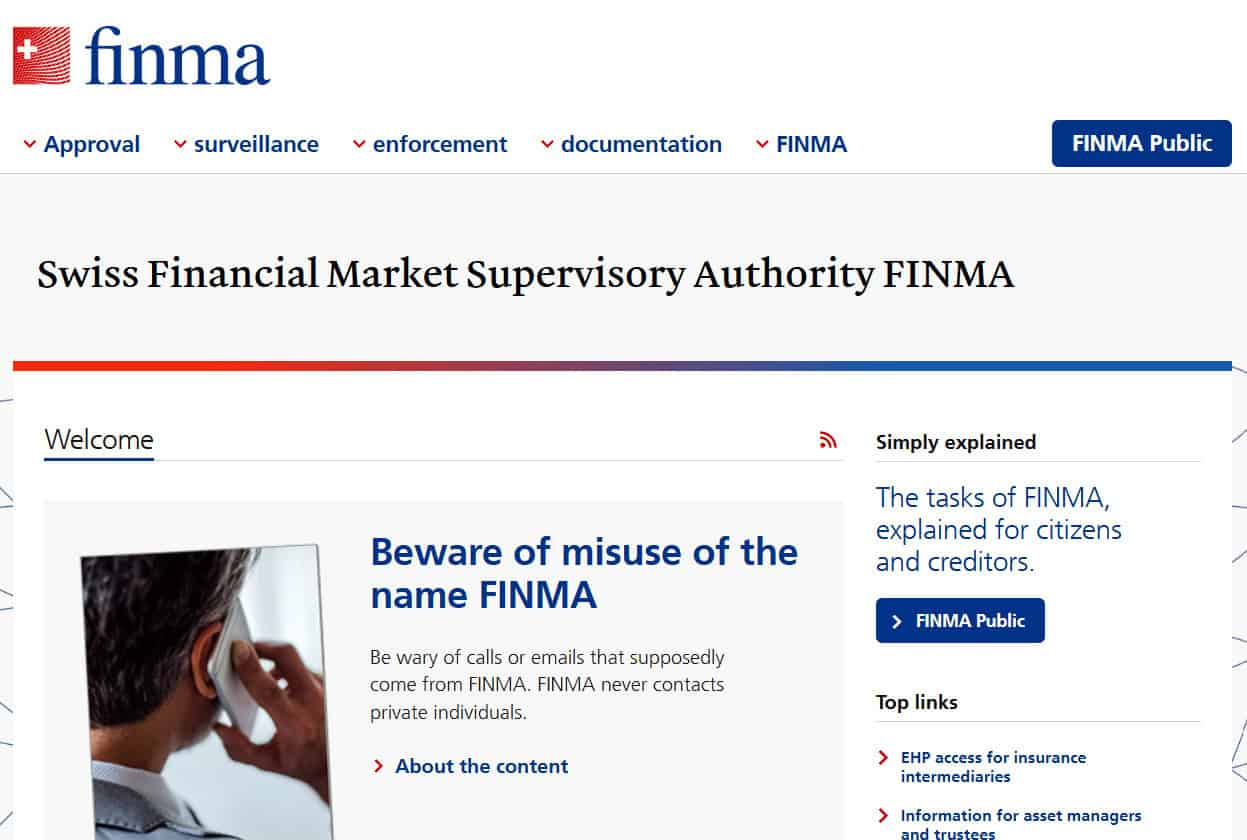
A few years earlier, just when online trading gained increased popularity, the Swiss Bank Directive issued a requirement for every broker operating within the country, obliging them to obtain a banking license from the Swiss Financial Market Supervisory Authority (FINMA) (read more via Wikipedia).
Moreover, the operational standards that are required of brokers are typical of how Swiss Banks operate, meaning Swiss Forex Brokers should operate through a banking license, likewise, and be fully regulated by FINMA as well.
Check FINMA website: www.finma.ch or follow its X – @FINMA_media.
- The process to obtain a FINMA license is not an easy one, as there is a serious requirement of sufficient capitalization, along with an agreement that protects customers up to 100,000 CHF in case a broker goes insolvent.
- In terms of client protection, Switzerland is considered one of the safest countries in the world with proven fair trading conditions.
- Due to stringent local regulatory requirements that mandate a significant base capital to start, as well as a set of strict procedures that are truly hard to meet, there aren’t many Swiss-based brokers.
Investor Protection Measures in Switzerland
Here, we have compiled a detailed overview of investor protection measures in Switzerland. Our focus is on regulation, protection measures, applied compensation plans, and the overall framework that ensures financial stability and investor safety.
- As mentioned, the Swiss Financial Market Supervisory Authority is the primary financial authority in Switzerland. It supervises and regulates banks, securities dealers, and other financial intermediaries. Its strict rules and guidelines ensure transparency, stability, and investor security.
- In Switzerland, all financial firms can obtain a FINMA license only after meeting strict criteria and capital adequacy requirements.
- Swiss regulation obligates all regulated brokers to follow account segregation rules. The segregation rule minimizes the risks of using clients’ investments for operational purposes.
- FINMA continuously oversees the market by conducting regular examinations and risk assessments.
- According to Swiss laws, eligible retail traders are covered up to CHF 100,000 per trader. However, losses resulting from trading decisions are not compensated.
- Financial firms in Switzerland must follow strict transparency rules, disclosing trading charges, investment risks, terms of service, etc.
- Swiss companies should also verify their clients’ identities and monitor transactions to avoid fraud and money laundering.
Switzerland Forex Brokers List
This is the full list of Regulated brokers that accept clients from Switzerland, selected and verified by us. The brokers ensure transparency and safety of the trading environment, efficiency of trades, and availability of advanced trading features.
| Broker | Detail |
|---|
How to Choose the Best Switzerland-Regulated Brokers
When assessing a forex broker licensed in Switzerland, traders should consider several crucial factors. In addition to strict regulatory rules, pricing transparency, functionality, available assets, and customer support are also essential.
- Strict regulation and regulatory compliance are essential for safe trading. Verify that the broker has a current license and is authorized to provide investment services.
- Check what protection mechanisms the broker offers. Swiss brokers usually include compensation plans and fund segregation.
- Carefully examine all the costs, including spreads, commissions, swap fees, and other applicable trading and non-trading fees. Clear pricing allows traders to avoid hidden charges.
- The broker’s reputation and track record are also essential to consider. Check traders’ feedback, trading history, and regulatory records.
- A reliable broker should include an advanced platform. Check for analytical tools, charts, and a good range of indicators.
- Also, check whether the broker provides the instruments you need. Not all FINMA-regulated brokers include the same range of financial assets, so confirming in advance is important.
- Check the available channels of customer support. Confirm the broker provides support in your preferred language. Support is especially helpful for beginner traders who might encounter different issues.
Pros and Cons of Switzerland-Regulated Brokers
Under Swiss regulation, choosing a reliable broker involves considering the pros and cons. While Swiss-regulated brokers ensure a safe trading environment and investor security, there are some restrictions traders should be aware of.
Here are the main benefits of trading with Swiss brokers:
- Strong regulation: FINMA-regulated brokers are required to maintain very high standards of capital, risk, and operational transparency.
- Protection measures: Swiss brokers are required to segregate clients’ accounts from their own assets. Additionally, retail clients are entitled to compensation in the event of the broker’s failure.
- The country’s legal stability is another essential advantage. It imposes clear legal obligations on financial firms, with defined rules and guidelines.
- Transparent trading conditions, fees, clear disclosure of risks, and warnings contribute to a safe and profitable trading experience.
Here are the main restrictions of trading with Swiss brokers:
- Although Swiss brokers follow compensation plans, they are limited to CHF 100,000. Thus, traders are not fully protected from investment risks.
- Swiss-regulated brokers are more focused on traditional financial markets rather than on speculative products. It is a limitation for traders seeking better market exposure and more opportunities.
- Leverage ratios are strictly limited in Switzerland. This conservative approach will not appeal to speculative traders looking for high leverage.
- Trading costs are higher than the average due to strict regulations that result in increased operational costs.
| Switzerland Trading Pros | Switzerland Trading Cons |
|---|---|
| Regulated by Top-Tier FINMA | Many offshore and scam Brokers attract Swiss clients |
| Excellent Client Protection and Compensation Scheme | Not Many brokers are FINMA regulated |
| Negative Balance Protection | Low leverage |
| High Leverage is available | |
| No Limits on Instruments including Binary Options trading | |
| Swiss Brokers are highly reputable | |
| Offers International Trading |
How to Verify a Switzerland-Regulated Forex Broker
To confirm that a broker is Switzerland-regulated, investors need to verify the license from FINMA, check the legal and operational disclosures, and protection measures. They can also test the actual interaction with the broker.
Here are the main steps to follow to verify a Swiss broker:
- Check the broker’s legal name and license number on the regulator’s public register. The authority lists all the regulated brokers with the essential and relevant information.
- Check whether the broker is authorised to provide the services you are interested in.
- Also, check the license validation. Some brokers continue to claim a license even after it expires.
- Inspect the legal documents the broker provides on its website. These include warnings, risk disclosures, terms and conditions, and anti-money laundering policies.
- Also, check the warning on the FINMA website. It constantly publishes notices and warnings about license suspension, fines, or license revocation.
- Check the broker’s customer support. Ensure it provides you with preferred options of communication and provides prompt and professional solutions.
- Check the broker’s reputation, operational history, and client feedback. Often, fellow traders share their experience with a broker, pointing out the strengths and weaknesses.
- At last, you can test a broker by opening a demo account or depositing a minimum amount. This will allow you to test the broker’s platform, the speed of deposits and withdrawals, customer support, and available tools and features.
Risks of Trading with Unregulated Brokers in Switzerland
Investors in Switzerland can face serious financial and legal risks if they trade with an unregulated broker. Unlicensed brokers function without oversight, capital requirements, or investor protection measures. On the contrary, brokers licensed by FINMA ensure safety and compliance with stringent rules.
Here are the risks Swiss brokers may face if they open an account with unregulated brokers:
- Without regulatory oversight, traders have limited protection against market risks. Unregulated brokers do not offer negative balance protection, compensation schemes, or account segregation.
- Unlicensed brokers often expose traders to fraud and scams. Some of the potential issues traders can face are unprocessed withdrawals, price manipulation, and disappearance or account freezing without prior notice.
- Lack of transparency is another issue that comes with unregulated brokers. They often impose hidden fees and do not fully disclose conditions, policies, and warnings.
- Unregulated brokers often attract traders with high leverage opportunities. However, high leverage exposes traders to rapid risks.
FINMA vs European brokers
The differences between FINMA-regulated brokers and brokers regulated by EU authorities lie in the structure of regulation, investor protection plans, leverage limitations, and market access.
- FINMA is under the Swiss financial law. It is not part of the EU and does not comply with the MiFID II rules. Most Swiss brokers are either banks or securities firms and require high capital. Under FINMA, traders are eligible for protection of up to CHF 100,000 and segregation of client funds. Besides, the authority imposes strict capital adequacy conditions. Leverage in Switzerland depends on the institutional structures. At last, there may be limitations for Swiss brokers in serving EU residents.
- European Brokers (EU) comply with MiFID rules and are simultaneously supervised by national regulators such as CySEC, BaFin, and AFM. EU brokers protect their clients with negative balance protection, compensation schemes, and account segregation. ESMA draws distinct limits for leverage (1:30 for major forex pairs for retail clients, and even lower for other instruments). EU brokers also benefit from cross-border passporting within the European Economic Area.
Leverage Limits in Switzerland
The leverage limits in Switzerland are set by individual brokers under the regulation of the Swiss Financial Market Supervisory Authority (FINMA). In contrast to ESMA-regulated European brokers, which have a maximum retail forex leverage of 1:30, Swiss brokers are free to set different leverage limits according to their internal risk management guidelines.
- However, Swiss brokers commonly offer between 1:50 and 1:100 for currency pairs, and lower ratios for commodities and cryptocurrencies.
Frequently Asked Questions
Are Swiss Brokers Safe for Forex Trading?
Swiss brokers regulated by FINMA are considered highly secure. They are subject to stringent capital requirements, risk controls, and transparency standards. The brokers also stand out for favorable conditions, competitive costs, and a good range of instruments.
Are Swiss Brokers Suitable for EU Residents?
Swiss brokers do not fall under the EU’s MiFID II system. Thus, the EU residents should check if the broker is legally permitted to offer their services in their country. As the Swiss brokers do not have EU passporting rights, services and protection measures may vary based on the client’s jurisdiction.
Is Crypto Legal in Switzerland?
Switzerland is a crypto-friendly country, with no restrictions on the buying and selling of virtual currency units or their use as a payment method. As such, citizens have complete freedom to participate in cryptocurrency activities without special approval or regulation from any governing body.
Is Cryptocurrency taxed in Switzerland?
Crypto is not exempt from the Swiss wealth tax system. Any past crypto transactions must be reported on the annual tax return to avoid penalties. Traders should ensure that they remain up-to-date with cryptocurrency taxes in Switzerland so as to uphold their financial obligations and responsibilities.
Can I Use Interactive Brokers in Switzerland?
Interactive Brokers, despite not being licensed by FINMA, is accessible to Swiss traders. This leading global broker offers a comprehensive set of trading tools and resources available to their international clients from Switzerland.
Is There a Forex Tax in Switzerland?
Retail traders are not required to pay any capital gains tax for their forex trading profits in Switzerland; however, professional traders are required to declare their trading income and submit an annual report to the relevant authorities.
What Is the Minimum Deposit with a Swiss Broker?
The minimum deposit requirements vary significantly. Due to bank-level operations for many brokers based in Switzerland, initial deposits may be higher compared to EU or offshore brokers.
Do Swiss Brokers Provide Negative Balance Protection?
Negative balance protection is not mandatory in Switzerland, unlike in the EU, where ESMA regulations make it mandatory. However, some brokers may choose to provide it voluntarily, but it is up to the trader to check this in the client agreement before opening an account.
What Trading Platforms Do Swiss Brokers Offer?
Swiss brokers often provide their own platforms or third-party platforms such as MetaTrader or institutional-level platforms. These platforms stand out for advanced capabilities, great charting, algorithmic trading, and research features.

